
What is a commercial data layer for retail & e-commerce data?
Henrik Hoffman·

Most retail and brand companies don’t lack data.
They have a lot of it.
Product data. Inventory data. Order data. Customer data. Marketing data. Website behavior. Cost structures.
The problem is not availability.
It’s that these data sets live next to each other, not together.
And as long as that’s true, teams are forced to make decisions based on partial truth. And agents are not much better at bringing large data sets from different tables.
The Core Tension
Retail and DTC teams are expected to make fast, confident, cross-functional decisions.
But the data they rely on is still organized by function, not by how the business actually works.
Marketing looks at channels. Merch looks at SKUs. Finance looks at margins. Ops looks at inventory.
Each view is correct on its own.
Together, they rarely connect.
This is exactly the gap a Commercial Data Layer is designed to close.
The common misunderstanding
Many people assume a Commercial Data Layer at an e-commerce is:
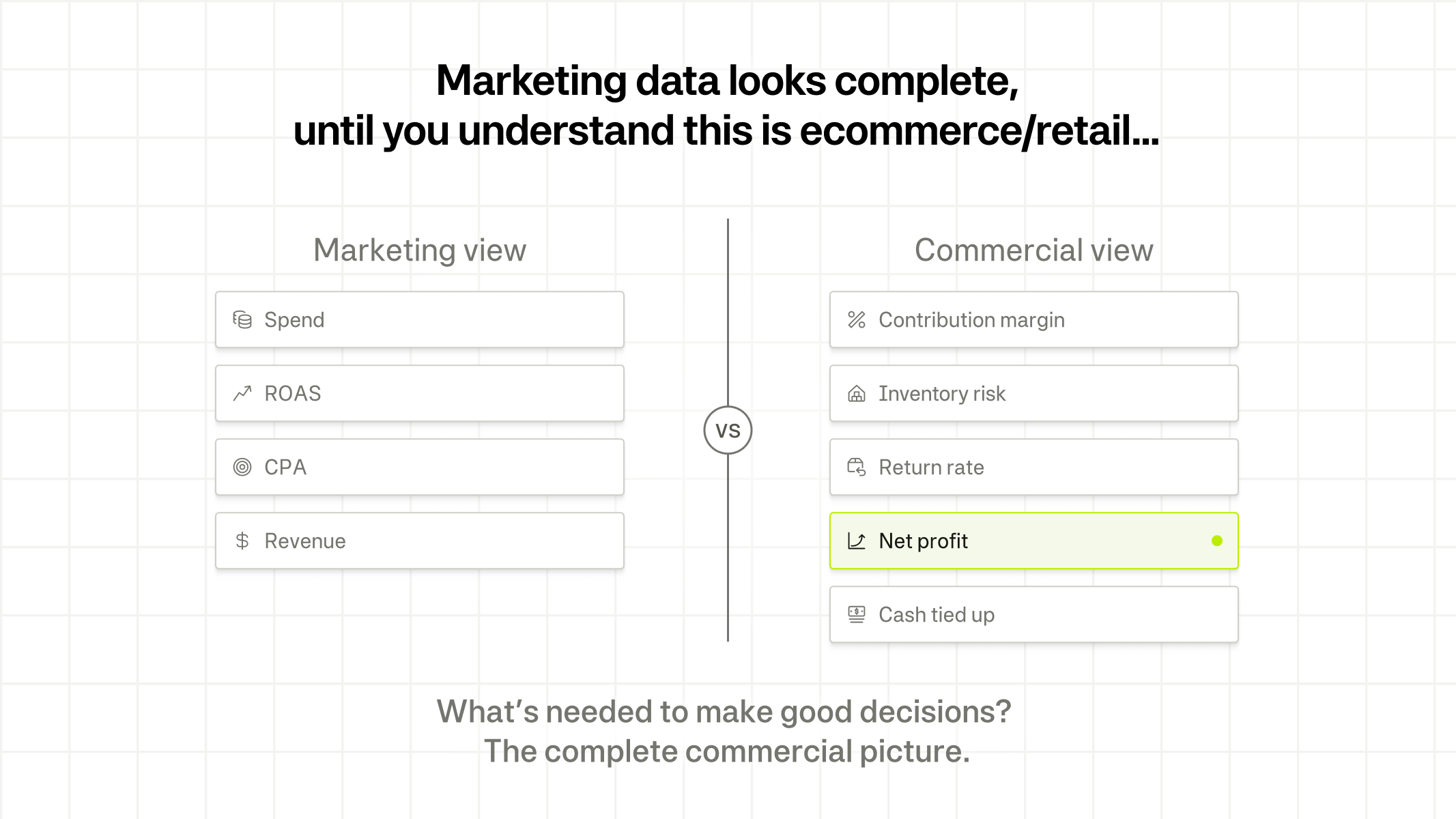
“Marketing data plus some costs.”
That’s not what it is.
And it’s why so many analytics stacks feel powerful, but fail under real decision pressure.
A Commercial Data Layer is not marketing-centric.
It is business-centric.
What a commercial data layer actually is
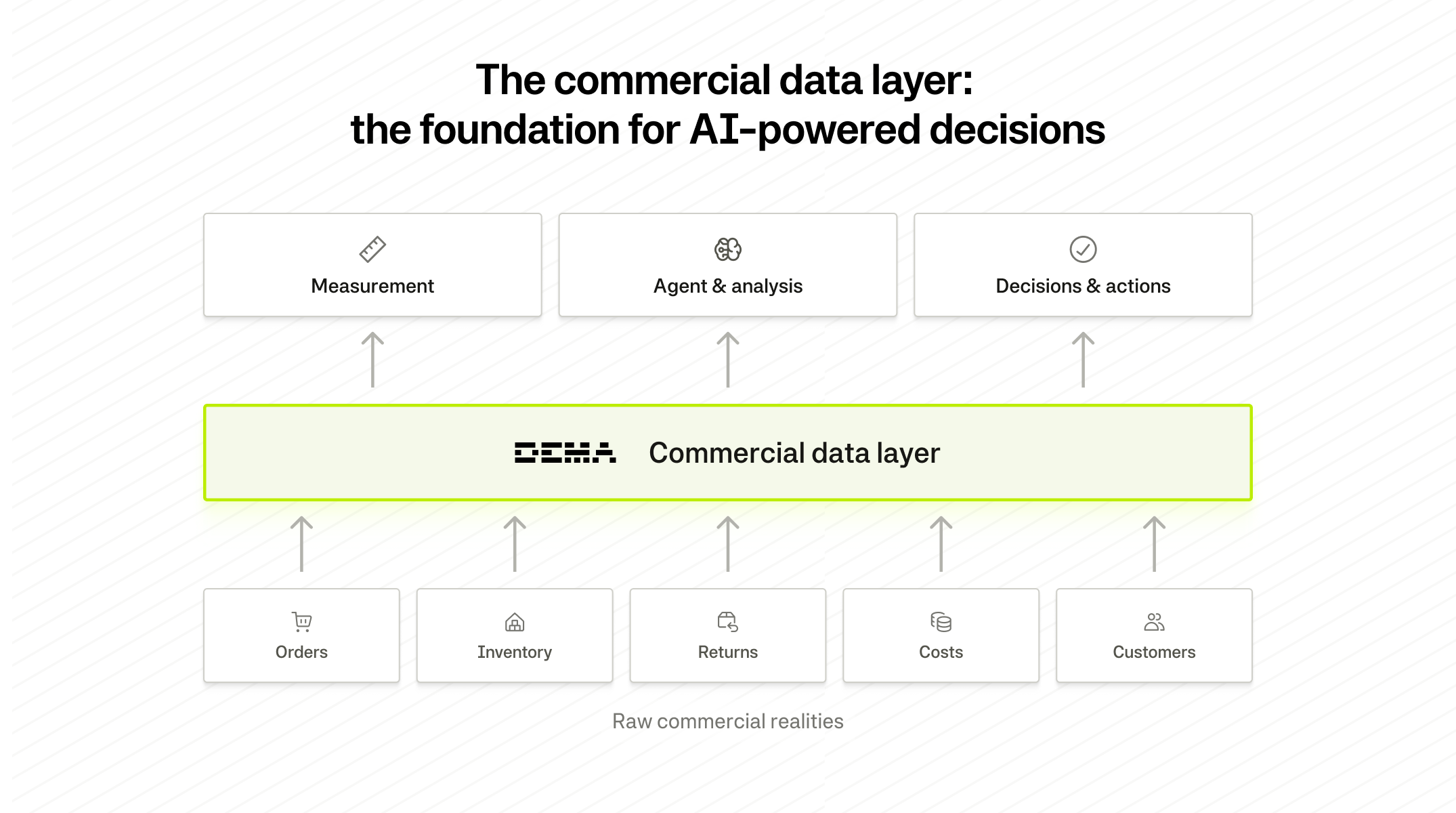
A Commercial Data Layer is a unified representation of how a retail or brand business truly operates.
It connects all commercial realities, including:
- Products & inventorySKUs, variants, stock levels, sell-through, availability constraints
- Orders & profitabilityBaskets, pricing, discounts, contribution margin, fulfillment and payment costs
- CustomersNew vs returning, cohorts, repurchase behavior, lifetime value
- ReturnsRates, timing, reasons, margin impact
- MarketingSpend, exposure, attribution, incrementality
- Behavior & demand signalsWebsite activity, conversion behavior, traffic patterns
All of this is connected at the order, product, and customer level.
Not summarized into reports. Not split by department. But structured as one system.
Why does this change everything?
Once data is structured this way, certain questions become easy, and unavoidable.
Not marketing questions.
Business questions.
- Which products are profitable to scale right now, given inventory and return risk?
- Which customers are we actually acquiring, and how do they behave over time?
- Which growth levers improve margin and cash flow, not just revenue?
- Where does demand creation collide with supply constraints?
These questions cannot be answered from any single functional dataset.
They require connected truth.
Why partial views quietly break decisions
When data stays fragmented, teams optimize locally.
Marketing optimizes acquisition. Merch optimizes sell-through. Finance optimizes margin.
But the business doesn’t operate in silos.
So you get outcomes like:
- profitable campaigns that accelerate stock-outs on the wrong SKUs
- strong growth that quietly destroys contribution margin
- customer acquisition that looks good short-term but never repays
No one is “wrong”.
They’re just not seeing the same system.
Why is this the only foundation an agent can actually trust?
This is where AI agents enter the picture, and where most narratives get it backwards.
Agents don’t struggle because they’re not advanced enough.
They struggle because they’re asked to reason across:
- disconnected datasets
- inconsistent definitions
- missing commercial context
In those environments, an agent has to:
- write complex SQL across systems
- infer business logic
- guess how data should relate
That’s not intelligence. That’s uncertainty.
And it fails often.
What changes when an agent sits on a commercial data layer
When a Commercial Data Layer exists, the agent’s role is completely different.
At Dema:
- the agent doesn’t need to stitch data together
- it doesn’t translate between systems
- it doesn’t invent assumptions
It makes simple API calls into a fully connected commercial model.
That’s why it can:
- reason across products, customers, inventory, margins, and marketing at once
- explain why something happened, not just what happened
- suggest actions that are commercially valid
The agent isn’t powerful just because it’s clever (though it needs to be clever, which results from really smart prompting, etc.).
It wouldn't matter how clever it was if it didn't have a coherent system underneath.
This is the real shift
Dashboards made fragmented data usable.
Agents make fragmentation visible.
As more teams adopt AI for analysis, the differentiator won’t be:
- which model you use
- which interface you prefer
It will be whether your data accurately reflects how the business actually operates.
Because in retail and DTC:
- marketing does not exist without inventory
- customers do not exist without products
- growth does not exist without margin
A Commercial Data Layer isn’t a feature.
It’s the prerequisite for making the business intelligible to humans and to machines.

Henrik Hoffman
Co-Founder & CCO
Henrik is Co-Founder and CMO of Dema. He focuses on marketing strategy and measurement, and is helping brands shift from vanity metrics to profit-driven decision-making.



Turn data into decisions.